
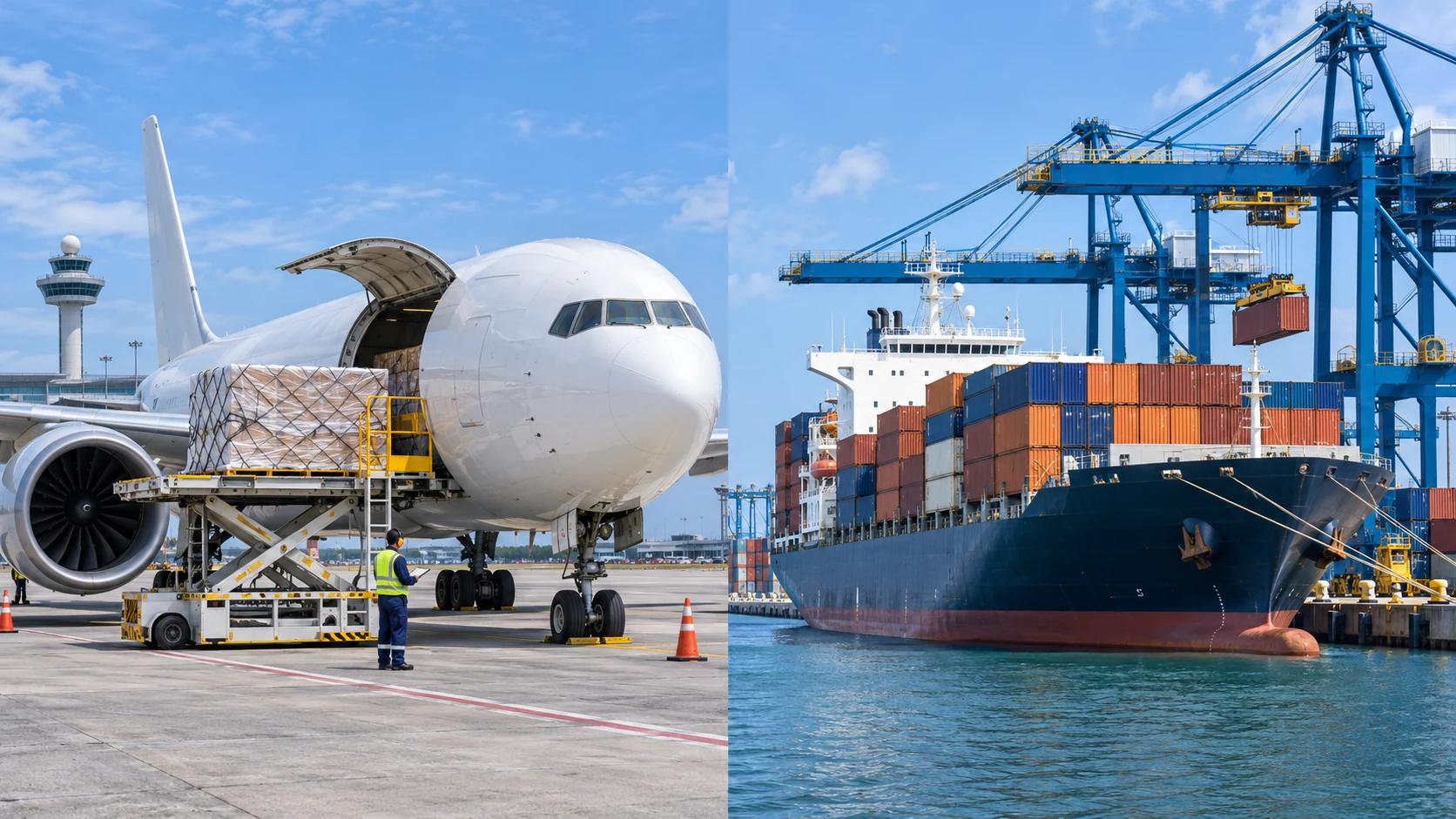
When businesses need to move cargo internationally, one of the first decisions is whether to use air freight or sea freight.
The answer usually comes down to three things:
- How quickly the cargo needs to arrive
- How much the shipment will cost
- What type and volume of cargo you are moving
For businesses looking for an air freight forwarder in Singapore, air freight can be the better option for urgent, high-value or smaller consignments. Sea freight, on the other hand, is often more suitable for larger commercial shipments where cost matters more than speed.
Neither option is automatically better.
The right choice depends on what your shipment actually needs.
Is Air Freight Faster Than Sea Freight?
Yes. Air freight is generally the better option when speed is the main priority.
Air cargo can move between international gateways much faster than ocean freight, which is why businesses often use it for urgent shipments.
Air freight may make sense for:
- Production-critical spare parts
- Product samples
- Urgent replenishment
- High-value cargo
- Time-sensitive customer orders
- Smaller consignments with strict deadlines
Zhenghe Logistics currently provides express and economy air freight through Singapore Changi. Its team reviews the cargo dimensions, weight, commodity and required delivery date before selecting an uplift option.
However, businesses should remember that flight time is only one part of the total journey.
Cargo still needs to go through:
- Pickup
- Export documentation
- Airline acceptance
- Departure
- Arrival
- Customs clearance
- Final delivery
So when comparing air and sea freight, ask for the expected end-to-end timeline, not only the transport time.
Is Sea Freight Cheaper Than Air Freight?
In most cases, sea freight is more cost-effective for larger or heavier shipments.
Airlines have limited cargo capacity, which means weight and space have a significant impact on air freight pricing.
Sea freight is generally more suitable when:
- Cargo volume is high
- Goods are heavy
- Delivery is not urgent
- Businesses are shipping multiple pallets
- Full container or consolidated shipping is practical
Zhenghe Logistics supports FCL, LCL and consolidation sea freight from Singapore, with the option selected based on cargo weight, volume and deadline.
However, businesses should not compare freight rates alone.
A lower sea freight rate may still come with additional costs for:
- CFS handling
- Port charges
- Storage
- Documentation
- Destination handling
- Final delivery
The better comparison is the total cost of getting the shipment to the consignee.
When Should You Choose Air Freight?
Choose air freight when the commercial value of speed outweighs the higher transport cost.
For example, imagine a manufacturing company is waiting for one replacement component.
Shipping the part by sea may be cheaper.
But if waiting several weeks causes a production line to stop, the cost of the delay could be far higher than the air freight charge.
This is why air freight can make commercial sense even when the freight rate itself is higher.
Air freight is often suitable for:
- Urgent spare parts
- Samples
- Electronics
- High-value goods
- Production-critical materials
- Small batches of inventory
- Time-sensitive retail goods
- Products with short delivery windows
Zhenghe specifically positions its air service for urgent spare parts, samples, production-critical cargo, high-value shipments and smaller consignments where speed is more important than ocean freight cost.
Businesses needing these types of movements can consider Zhenghe's air freight services in Singapore as part of their freight planning.
When Should You Choose Sea Freight?
Choose sea freight when cargo volume and cost efficiency matter more than speed.
Sea freight is commonly used for:
- Larger commercial shipments
- Palletised goods
- Regular inventory replenishment
- Raw materials
- Machinery
- Consumer products
- Containerised cargo
Businesses may choose between:
FCL
Full Container Load means your cargo uses a dedicated container.
FCL can make sense when shipment volume is high enough to justify container capacity or when businesses prefer fewer consolidation handling stages.
LCL
Less than Container Load means your cargo shares container space with other shipments.
LCL can suit smaller shipments that do not require a full container.
Zhenghe's sea freight service includes both FCL and LCL, together with consolidation support, origin receiving, CFS handling and carrier coordination.
Businesses moving larger or less urgent cargo can therefore consider sea freight services in Singapore before defaulting to air cargo.
Which Is Better for Small Shipments?
It depends on urgency and total cost.
A small shipment does not automatically mean air freight.
Suppose your business has two pallets of non-urgent stock.
Air freight may move them faster, but LCL sea freight could still be significantly more economical if delivery time is flexible.
On the other hand, several cartons of urgent production components may be much better suited to air freight.
Ask:
- When does the cargo need to arrive?
- What happens if it arrives late?
- How large is the shipment?
- How heavy is it?
- Is the cargo high in value?
- Can the business wait for sea freight?
These questions usually provide a clearer answer than shipment size alone.
Which Is Better for Large or Heavy Cargo?
Sea freight is generally the first option to assess for large and heavy commercial shipments.
Air freight becomes increasingly expensive as cargo occupies more aircraft capacity.
Large shipments may also face airline size or acceptance restrictions.
Sea freight provides more flexibility for:
- Full containers
- Large pallet quantities
- Heavy commercial goods
- Machinery
- Consolidated cargo
- Oversized shipments
For particularly large or unusual cargo, businesses should provide full dimensions and weight before requesting a quote.
A freight forwarder can then assess whether standard sea freight, specialised equipment or another solution is needed.
How Do Air Freight and Sea Freight Costs Work?
Air and sea freight use different pricing structures.
Air Freight
Air freight pricing is heavily influenced by chargeable weight.
The carrier compares the shipment's actual weight with its volumetric weight and applies the relevant chargeable figure.
This means a lightweight but very large carton can still be expensive to send by air because it occupies significant aircraft space.
Important quote details include:
- Gross weight
- Number of packages
- Dimensions
- Commodity
- Origin
- Destination
- Required delivery date
Sea Freight
Sea freight pricing differs depending on whether cargo moves as FCL or LCL.
FCL pricing is generally based around the container movement.
LCL pricing is influenced by cargo volume and other origin and destination handling charges.
Important quote details include:
- Total CBM
- Gross weight
- Number of pallets or cartons
- Container requirement
- Origin and destination
- Cargo-ready date
- Incoterm
- Final delivery requirements
Accurate cargo information is essential for both modes.
What Type of Cargo Can Move by Air Freight?
Many commercial goods can move by air, but airline acceptance requirements still apply.
An air cargo Singapore shipment may require additional review if it contains:
- Batteries
- Chemicals
- Dangerous goods
- Liquids
- Temperature-sensitive products
- Oversized cargo
Zhenghe's air freight workflow includes reviewing cargo constraints and airline acceptance requirements before booking. Commodity permits, MSDS or battery documentation may also be required depending on the shipment.
Businesses should therefore provide an accurate commodity description before confirming an air booking.
Do not simply describe the goods as “general cargo” if more specific information is available.
What Type of Cargo Is Better Suited to Sea Freight?
Sea freight is typically better suited to larger volumes, routine inventory and cargo without an urgent delivery deadline.
Examples include:
- Consumer goods
- Furniture
- Machinery
- Raw materials
- Packaging
- Multiple pallets
- Regular inventory replenishment
Sea freight may also be more suitable when the physical dimensions make air transportation impractical or expensive.
Again, the best mode depends on the actual cargo rather than the product category alone.
Should You Use Air Freight for High-Value Cargo?
Air freight can be useful for high-value cargo when speed and shipment visibility are important.
A shorter transport cycle can reduce the amount of time goods spend moving between locations.
However, value alone should not determine the freight mode.
Businesses should also consider:
- Cargo dimensions
- Insurance
- Security requirements
- Packaging
- Handling
- Destination clearance
- Delivery urgency
Zhenghe's air freight service is positioned for high-value shipments requiring tighter milestone visibility, alongside urgent and production-critical movements.
What Documents Do You Need for Air and Sea Freight?
Both modes require accurate commercial and transport documents.
Common documents include:
- Commercial invoice
- Packing list
- Customs documentation
- Commodity permits where required
Air freight additionally uses an Air Waybill.
Sea freight typically uses a Bill of Lading.
For sea freight, a Certificate of Origin may also be required depending on the destination and transaction. Zhenghe's sea freight service lists commercial invoices, packing lists, Bill of Lading instructions and Certificates of Origin among common shipment documents.
Documentation should be checked before the relevant cargo cutoff.
How Do You Choose Between Air Freight and Sea Freight?
Start with cost, speed and cargo profile.
A simple comparison looks like this:
| Factor | Air Freight | Sea Freight |
|---|---|---|
| Speed | Faster | Slower |
| Cost | Usually higher | Usually lower for larger shipments |
| Small urgent cargo | Strong fit | Possible, but slower |
| Large cargo volume | Can become expensive | Strong fit |
| High-value cargo | Often suitable | Depends on urgency |
| Routine inventory | Usually less economical | Often suitable |
| FCL/LCL options | No | Yes |
| Urgent spare parts | Strong fit | Usually not ideal |
The right choice is therefore not simply:
Which mode is cheaper?
It is:
Which mode gives the business the best balance of freight cost, delivery time and operational risk?
How Can a Freight Forwarder Help You Decide?
A freight forwarding service in Singapore should assess the shipment before recommending a mode.
Provide your freight forwarder with:
- Origin
- Destination
- Cargo description
- Number of packages
- Dimensions
- Gross weight
- Cargo-ready date
- Required delivery date
- Incoterm if known
- Special handling requirements
With this information, the operations team can compare practical air and sea freight options.
Zhenghe Logistics currently operates both air and sea freight services from Singapore, allowing its freight team to review the cargo requirement rather than automatically pushing one transport mode. Its air offering includes express and economy uplift, while its sea service includes FCL, LCL and consolidation.
Frequently Asked Questions
Is air freight better than sea freight?
Neither mode is always better. Air freight is generally more suitable when speed is critical, while sea freight is often more cost-effective for larger or less urgent shipments. The right choice depends on the cargo size, weight, value, destination and required delivery date.
Is air freight more expensive than sea freight?
Air freight is generally more expensive, especially for large or heavy cargo. However, businesses should also consider the cost of delays. Paying more for air freight may still make commercial sense if slower shipping would interrupt production or cause a customer deadline to be missed.
When should I use an air freight forwarder in Singapore?
Consider an air freight forwarder when you have urgent, high-value, production-critical or smaller cargo that needs faster international transport. The forwarder can help assess routing, airline requirements, documentation and shipment milestones.
Can small shipments go by sea freight?
Yes. Smaller shipments can move through LCL sea freight, where cargo shares container capacity with other shipments. LCL may be suitable when the goods are not urgent and the business wants a more economical alternative to air freight.
What information do I need for a freight quote?
Prepare the origin, destination, commodity, number of packages, cargo dimensions, gross weight, cargo-ready date and required delivery date. Include any special handling requirements and the Incoterm if known.
This guidance is indicative. Carrier space, cutoffs, handling requirements and destination conditions should be confirmed for each movement.